Templates
Both templates hold the same schematic, the same ID EEPROM and the same board outline from Raspberry Pi's HAT mechanical drawing. They differ in the GPIO connector, J1, and that decides how the board meets the Pi.
RPi_Hat_THT |
RPi_Hat_SMD |
|
|---|---|---|
| J1 | 2×20 through-hole, 2.54 mm pitch | Samtec HLE-120-02-xxx-DV-BE surface-mount socket |
| Mounted | A female socket on the underside, onto the Pi's pins | On the top side; the Pi's pins come up through the board into it |
| Board | 65 × 56 mm | 65 × 56.5 mm |
| Stack height | Set by the socket you fit: any 2×20 female header or stacking header | As low as the Pi's header allows (see below) |
| Extra design rule | One thermal spoke allowed on J1's GND pins | 0.127 mm pad-to-hole clearance allowed inside the socket |
The board sizes follow the drawing: 65 × 56.5 mm for an SMT-style GPIO header, 65 × 56 mm for a through-hole one.
Stack height decides the choice
The HAT+ specification recommends spacers of at least 15 mm between the Pi and a HAT+, 16 mm ideally, so a Raspberry Pi 5 Active Cooler fits underneath, and more if your HAT has parts on its underside.
Through-hole meets that with the right part. The footprint is just the 40 holes, so fit whichever female header or stacking header gives the height you need, with spacers of the same height.
SMD cannot be raised. Samtec's -BE option is bottom entry: the socket
sits on top of the HAT and the Pi's pins pass up through the board into it,
needing at least 2.59 mm of insertion
(HLE datasheet). The
HAT therefore sits about as low as the Pi's own header body, well under 15 mm.
Use it for a low-profile HAT on a Pi with nothing tall under the HAT area, not
on a Pi 5 with an Active Cooler.
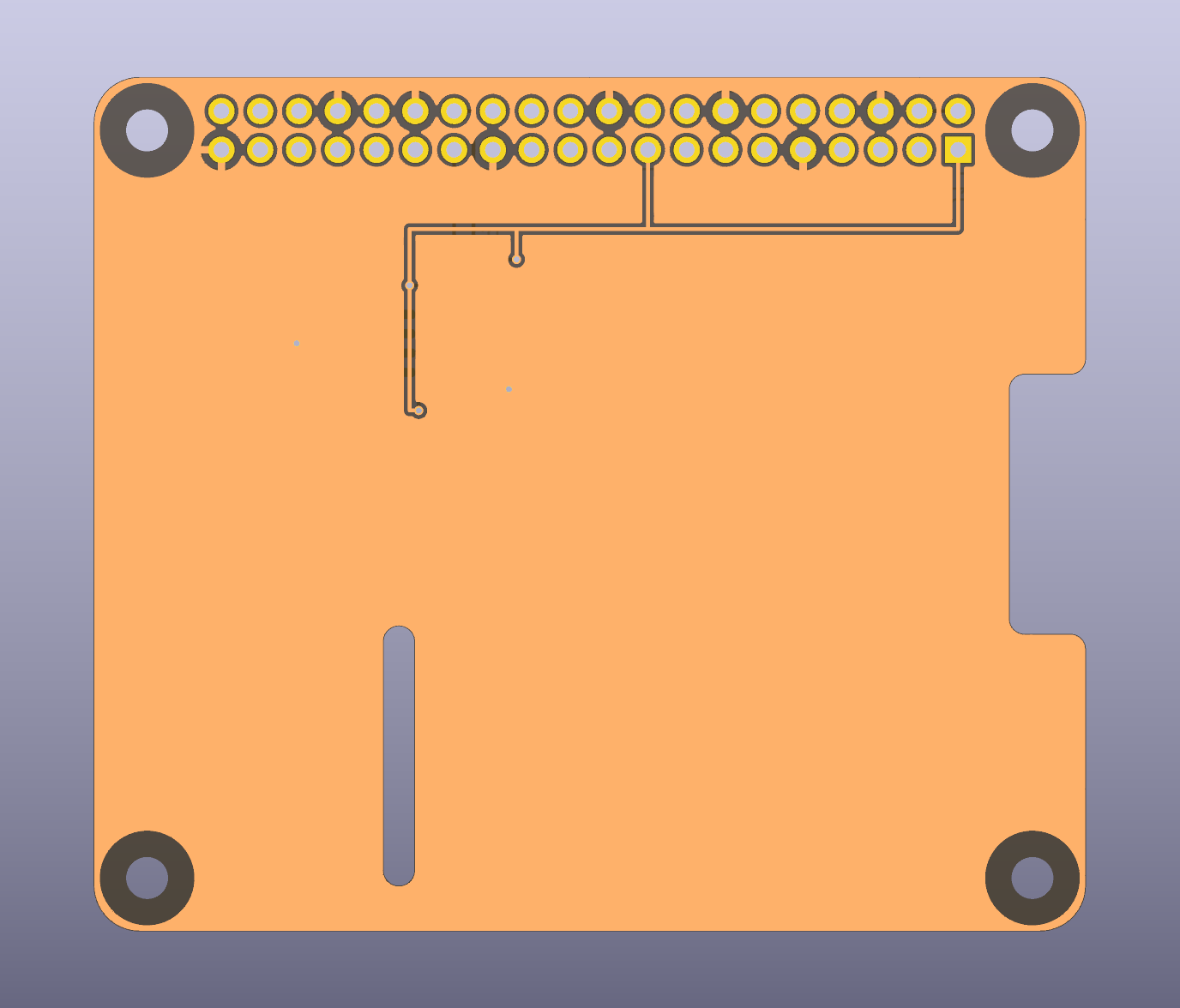
What both templates hold
- The outline with the display flex cut-out and the camera flex slot, the
drawing's dimensions on
Dwgs.User, and four M2.5 mounting holes. See Mechanical. - J1, placed and locked at the drawing's position.
- The schematic: J1's power pins wired, a global label on each GPIO pin, and the ID EEPROM. See the GPIO pinout and ID EEPROM.
- The board: the EEPROM block routed, a GND pour on
B.Cu. See Board design. - Their own
RPi_Hatlibraries; the two copies are identical, and CI checks that they stay so.
Where they live
RPi_Hat_THT/ and RPi_Hat_SMD/ in the
repository. Each folder's
meta/ holds what KiCad shows in its template chooser.