4.8.8
Defined in src/semi_regular/tess_4_8_8.scad. The 4.8.8 tiling, also called the truncated square tiling, has one
square and two octagons at every vertex.
Everything is sized by radius, the distance from an octagon’s centre to one of its corners. The octagon’s edge
length follows from it, and the squares have the same edge length:
side_length = (radius * 2) / sqrt(4 + 2 * sqrt(2)); // about 0.765 * radius
Theory derives this.
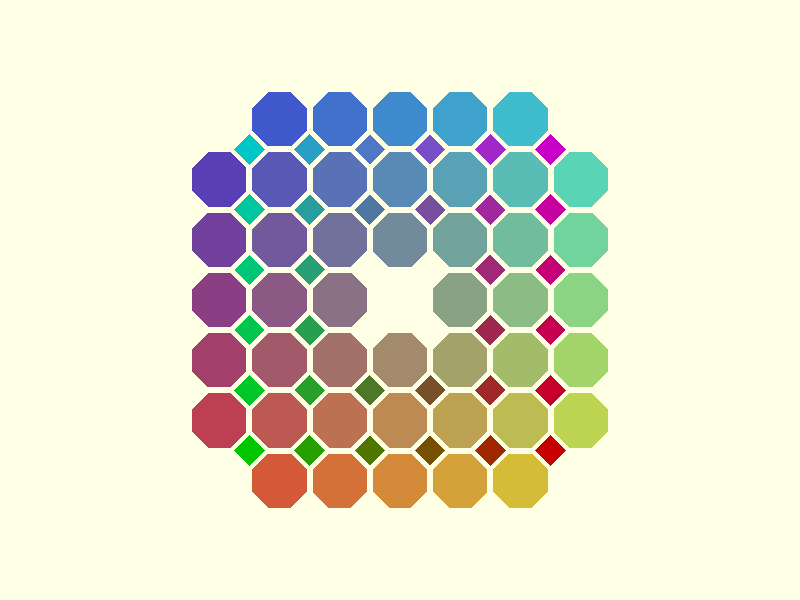
A complete pattern
use <tessella/tess.scad>

radius = 10;
n = 4;
m = 3;

oct_centers = octagons_centers_rect(radius, n, m);
sq_centers = squares_8_8_centers_rect(radius, n, m);

side_length = (radius * 2) / sqrt(4 + 2 * sqrt(2));

generic_poly(
    vertices = octagons_vertices(radius, oct_centers),
    paths = [[0, 1, 2, 3, 4, 5, 6, 7, 0]],
    centers = oct_centers,
    color_scheme = "scheme2"
);

generic_poly(
    vertices = squares_vertices(side_length, sq_centers, angular_offset = 0),
    paths = [[0, 1, 2, 3, 0]],
    centers = sq_centers,
    color_scheme = "scheme1"
);
The squares are drawn with squares_vertices() from Squares, with angular_offset = 0. The gap
between four octagons is a square standing on a corner, and the default offset of 45 would draw it axis-aligned.
octagons_centers_rect
octagons_centers_rect(radius, n, m)
Returns the centres of an n by m grid of octagons.
| Parameter | Meaning |
|---|---|
radius |
Centre-to-corner distance |
n |
Number of octagons along X |
m |
Number of octagons along Y |
The pitch in both directions is the octagon’s width across the flats, side_length * (1 + sqrt(2)), which is
radius * 2 * cos(22.5). The first centre is at the origin. The result has n * m points.
use <tessella/tess.scad>

echo(octagons_centers_rect(10, 2, 2));
// ECHO: [[0, 0], [0, 18.4776], [18.4776, 0], [18.4776, 18.4776]]
squares_8_8_centers_rect
squares_8_8_centers_rect(radius, n, m)
Returns the centres of the squares that fill the gaps in an n by m grid of octagons.
| Parameter | Meaning |
|---|---|
radius |
Centre-to-corner distance of the octagons |
n |
Number of octagons along X |
m |
Number of octagons along Y |
Call it with the same arguments as octagons_centers_rect(). Each square sits where four octagons meet, so the
result has (n - 1) * (m - 1) points, and is empty when n or m is 1.
use <tessella/tess.scad>

echo(squares_8_8_centers_rect(10, 3, 3));
// ECHO: [[9.2388, 9.2388], [9.2388, 27.7164], [27.7164, 9.2388],
//        [27.7164, 27.7164]]
octagons_vertices
octagons_vertices(radius, centers, angular_offset = 22.5)
Returns the eight corners of an octagon around each centre.
| Parameter | Meaning |
|---|---|
radius |
Centre-to-corner distance of the octagons drawn |
centers |
List of centre points |
angular_offset |
Angle of the first corner from +X; 22.5 puts flat edges on the axes |
Corners are listed anticlockwise. Keep the default angular_offset with centres from octagons_centers_rect().
Pass a radius smaller than the one the centres were laid out with to leave a gap. The gap between neighbouring
octagons is 2 * cos(22.5), about 1.848, times the difference. To get the same gap between an octagon and a square,
shrink the squares’ side by that same 1.848 times the amount you shrink the octagons’ radius.
Render with paths = [[0, 1, 2, 3, 4, 5, 6, 7, 0]].
Known issues
- There is no radial layout for this tiling.
tess_4_8_8.scadcallssquares_centers_rect()but does not importsquares.scad. Imported on its own, both centres functions returnundefwith anIgnoring unknown functionwarning. Importtess.scadinstead.- The source comment for
octagons_centers_rect()documents arotateparameter. The function does not have one.