Hexagons
Defined in src/regular/hexagons.scad. Hexagons are sized by radius, the distance from the centre to a corner,
which for a regular hexagon equals the edge length. The distance across the flats is radius * sqrt(3).
The layouts place hexagons with a corner pointing up. Theory derives the spacing.
hexagons_centers_rect
hexagons_centers_rect(radius, n, m)
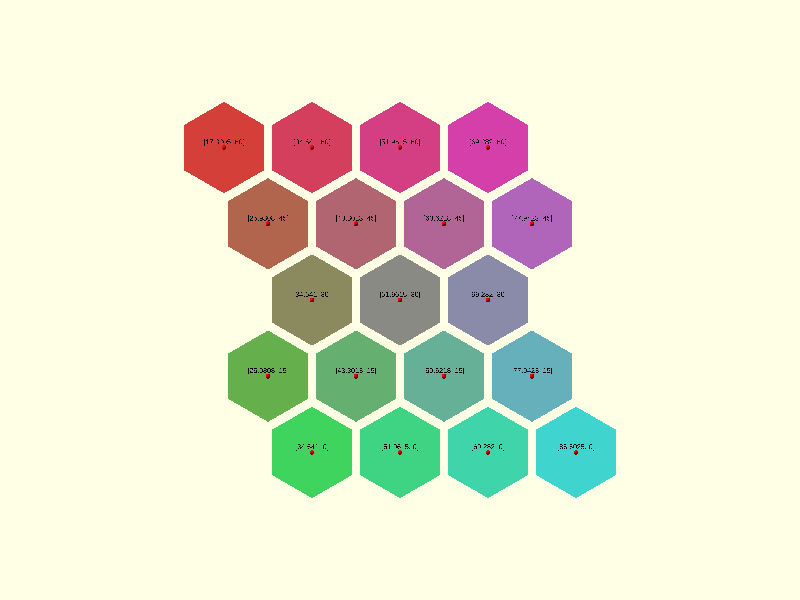
Returns the centres of m rows of n hexagons, the regular 6.6.6 tiling.
| Parameter | Meaning |
|---|---|
radius |
Centre-to-corner distance |
n |
Number of hexagons in each row |
m |
Number of rows |
Hexagons in a row are radius * sqrt(3) apart. Rows are radius * 1.5 apart, and odd rows are shifted half a
hexagon toward +X. The first centre is at the origin. The result has n * m points.
use <tessella/tess.scad>

echo(hexagons_centers_rect(10, 3, 2));
// ECHO: [[0, 0], [8.66025, 15], [17.3205, 0], [25.9808, 15], [34.641, 0],
//        [43.3013, 15]]
hexagons_centers_radial
hexagons_centers_radial(radius, levels)
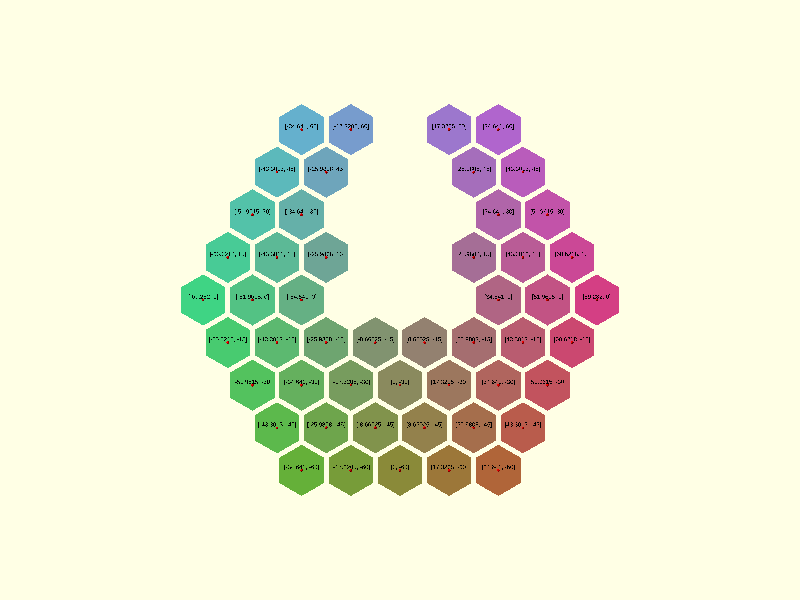
Returns the centres of a hexagon surrounded by complete rings of hexagons.
| Parameter | Meaning |
|---|---|
radius |
Centre-to-corner distance |
levels |
Number of rings, counting the central hexagon as one |
The pattern is centred on the origin. The result has 3 * levels^2 - 3 * levels + 1 points: 1, 7, 19, 37, 61 for
levels 1 to 5.
use <tessella/tess.scad>

echo(hexagons_centers_radial(10, 2));
// ECHO: [[-17.3205, 0], [0, 0], [17.3205, 0], [-8.66025, 15], [8.66025, 15],
//        [-8.66025, -15], [8.66025, -15]]
hexagons_vertices
hexagons_vertices(radius, centers, angular_offset = 30)
Returns the six corners of a hexagon around each centre.
| Parameter | Meaning |
|---|---|
radius |
Centre-to-corner distance of the hexagons drawn |
centers |
List of centre points |
angular_offset |
Angle of the first corner from +X; 30 puts a corner pointing up |
Corners are listed anticlockwise. Keep the default angular_offset with centres from the two functions above. Another
angle rotates each hexagon in place, and unless the change is a multiple of 60 they no longer fit together.
Pass a radius smaller than the one the centres were laid out with to leave a gap. The gap between neighbouring
hexagons is sqrt(3) times the difference.
use <tessella/tess.scad>

echo(hexagons_vertices(10, [[0, 0]]));
// ECHO: [[[8.66025, 5], [0, 10], [-8.66025, 5], [-8.66025, -5], [0, -10],
//        [8.66025, -5]]]
Render with paths = [[0, 1, 2, 3, 4, 5, 0]].