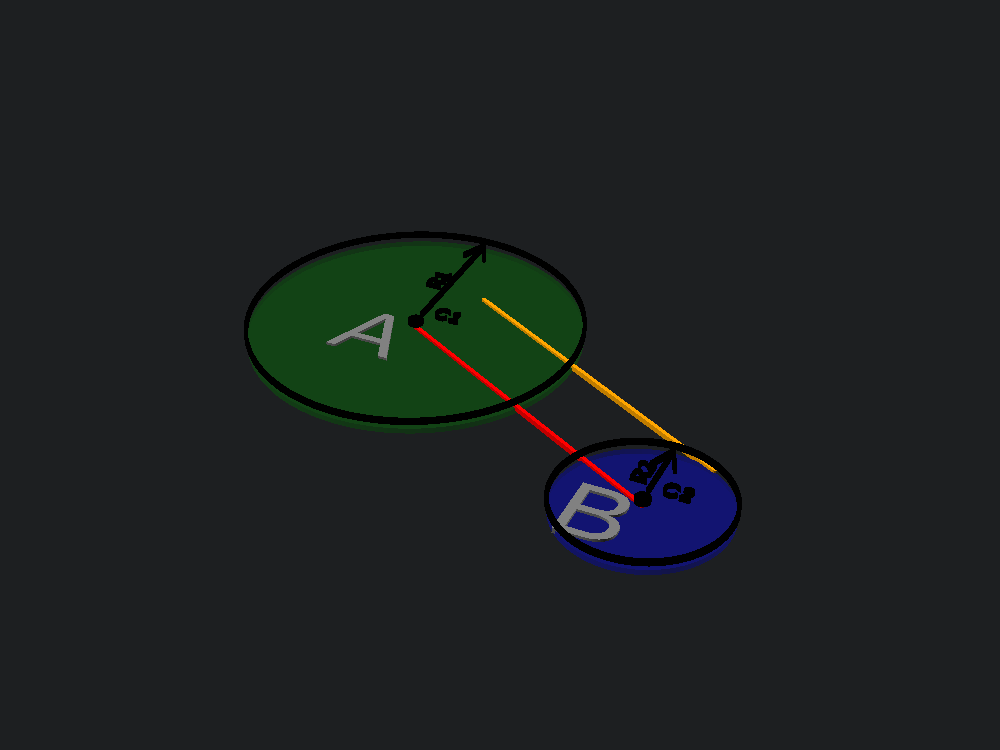
// Tutorial Tangent Lines.scad
//
// This is a script used for a tutorial about
// the tangent lines of a circle.
// This tutorial uses the file "tangent_lines.scad".
//
// Version 1
// October 6, 2024
// by: Stone Age Sculptor
// License: CC0 (Public Domain)
// Compatible with OpenSCAD version from 2021 and 2024.
//
// Version 2
// October 11, 2024
// by: Stone Age Sculptor
// License: CC0 (Public Domain)
//   Demonstration added for intersection
//   and connection points for circles.
//

$fn = 100;

include <tangent_lines.scad>

assert(TANGENT_LINES_VERSION >= 3, "Use at least version 3 of \"tangent_lines.scad\"");

// The part of the tutorial.
tutorial_section = 0; // [0:1:9]

// The line width, which is used throughout the whole script.
line_width = 0.7;

// The two circles, used for the tutorial.
C1 = [ -35, 25 ];
R1 = 30;
N1 = "A";
F1 = "Green";

C2 = [ 20, -5 ];
R2 = 15;
N2 = "B";
F2 = "Blue";

Tutorial(tutorial_section);

module Tutorial(tutorial)
{
    if (tutorial == 0)
    {
        // Classic way for external tangent lines,
        // with a parallel line inside the circle.

        TutorialCircle(C1, "C1", R1, "R1", N1, F1);
        TutorialCircle(C2, "C2", R2, "R2", N2, F2);

        // Draw a line between the centre points.
        translate([ 0, 0, 0.5 ]) color("Red") Line(C1, C2);

        // Draw the parallel line.
        a = atan2((C1 - C2).y, (C1 - C2).x) + 180;
        Vector = [ cos(a + 90), sin(a + 90) ];
        Z1 = C1 + R2 * Vector;
        Z2 = C2 + R2 * Vector;
        translate([ 0, 0, 0.5 ]) color("Orange") Line(Z1, Z2);
    }
    else if (tutorial == 1)
    {
        // Classic way for internal tangent lines,
        // with a parallel line outside the circle.

        TutorialCircle(C1, "C1", R1, "R1", N1, F1);
        TutorialCircle(C2, "C2", R2, "R2", N2, F2);

        // Draw a line between the centre points.
        translate([ 0, 0, 0.5 ]) color("Red") Line(C1, C2);

        // Draw the parallel line.
        a = atan2((C1 - C2).y, (C1 - C2).x) + 180;
        Vector = [ cos(a + 90), sin(a + 90) ];
        Z1 = C1 + R1 * Vector;
        Z2 = C2 + R1 * Vector;
        translate([ 0, 0, 0.5 ]) color("Orange") Line(Z1, Z2);
    }
    else if (tutorial == 2)
    {
        // Calculate the tangent points
        // with the common tangent point and
        // similar triangles.

        TutorialCircle(C1, "C1", R1, "R1", N1, F1);
        TutorialCircle(C2, "C2", R2, "R2", N2, F2);

        // The external tangent point for the two circles.
        T1 = PointForExternal(C1, R1, C2, R2);
        // The tangent points for the first circle.
        P1 = TangentPoints(C1, R1, T1);
        // The tangent points for the second circle.
        P2 = TangentPoints(C2, R2, T1);

        // Draw the points and the tangent lines.
        // Height level 5.
        translate([ 0, 0, 5 ]) color("Blue")
        {
            Point(T1, "T1");
            Point(P1[0], "P1[0]");
            Point(P1[1], "P1[1]");
            Point(P2[0], "P2[0]");
            Point(P2[1], "P2[1]");

            // Lines are draw to all the tangent lines.
            // That means that they will overlap,
            // which is no problem.
            Line(T1, P1[0]);
            Line(T1, P1[1]);
            Line(T1, P2[0]);
            Line(T1, P2[1]);
        }

        // Draw two triangles.
        // Height level 4.
        translate([ 0, 0, 4 ])
        {
            color("LawnGreen", 0.5) polygon([ C1, P1[1], T1 ]);
            translate([ 0, 0, 0.5 ]) color("Orange", 0.8) polygon([ C2, P2[1], T1 ]);
        }
    }
    else if (tutorial == 3)
    {
        // Calculate the tangent points
        // with the common tangent point
        // and similar triangles.

        TutorialCircle(C1, "C1", R1, "R1", N1, F1);
        TutorialCircle(C2, "C2", R2, "R2", N2, F2);

        // The internal tangent point for the two circles.
        T2 = PointForInternal(C1, R1, C2, R2);
        // The tangent points for the first circle.
        Q1 = TangentPoints(C1, R1, T2);
        // The tangent points for the second circle.
        Q2 = TangentPoints(C2, R2, T2);

        // Draw the points and the tangent lines.
        // Height level 5.
        translate([ 0, 0, 5 ]) color("Red")
        {
            Point(T2, "T2");
            Point(Q1[0], "Q1[0]");
            Point(Q1[1], "Q1[1]");
            Point(Q2[0], "Q2[0]");
            Point(Q2[1], "Q2[1]");

            // Lines are draw to all the tangent lines.
            // That means that they will overlap,
            // which is no problem.
            Line(T2, Q1[0]);
            Line(T2, Q1[1]);
            Line(T2, Q2[0]);
            Line(T2, Q2[1]);
        }

        // Draw two triangles.
        // Height level 4.
        translate([ 0, 0, 4 ])
        {
            color("LawnGreen", 0.5) polygon([ C1, Q1[1], T2 ]);
            translate([ 0, 0, 0.5 ]) color("Orange", 0.8) polygon([ C2, Q2[1], T2 ]);
        }
    }
    else if (tutorial == 4 || tutorial == 5)
    {
        // A demonstration for tangent lines.
        // I have my doubts if this is a good demonstration,
        // because a similar shape can be made with the
        // offset() function or with bezier functions.

        C10 = [ 0, 120 ];
        R10 = 15;
        C11 = [ 40, 110 ];
        R11 = 22;
        C12 = [ 30, 70 ];
        R12 = 15;
        C13 = [ 55, 40 ];
        R13 = 20;
        C14 = [ 50, 15 ];
        R14 = 15;

        T10 = PointForInternal(C10, R10, C11, R11);
        T11 = PointForInternal(C11, R11, C12, R12);
        T12 = PointForInternal(C12, R12, C13, R13);
        T13 = PointForExternal(C13, R13, C14, R14);

        P11 = TangentPoints(C10, R10, T10)[0];
        P12 = TangentPoints(C11, R11, T10)[0];
        P13 = TangentPoints(C11, R11, T11)[1];
        P14 = TangentPoints(C12, R12, T11)[1];
        P15 = TangentPoints(C12, R12, T12)[0];
        P16 = TangentPoints(C13, R13, T12)[0];
        P17 = TangentPoints(C13, R13, T13)[1];
        P18 = TangentPoints(C14, R14, T13)[1];
        P19 = TangentPoints(C14, R14, [ 0, 0 ])[1];

        if (tutorial == 4)
        {
            translate([ 0, 0, 1 ])
            {
                color("Blue") translate(C10) circle(R10);

                color("Red") translate(C11) circle(R11);

                color("LawnGreen") translate(C12) circle(R12);

                color("Orange") translate(C13) circle(R13);

                translate([ 0, 0, 0.5 ]) color("Purple") translate(C14) circle(R14);
            }
            translate(C11) circle(R11);
            translate(C13) circle(R13);
            translate(C14) circle(R14);
            polygon([ [ 0, 0 ], [ 0, C10.y - R10 ], P11, P12, P13, P14, P15, P16, P17, P18, P19 ]);
        }

        if (tutorial == 5)
            rotate_extrude() difference()
            {
                union()
                {
                    translate(C11) circle(R11);
                    translate(C13) circle(R13);
                    translate(C14) circle(R14);
                    polygon([ [ 0, 0 ], [ 0, C10.y - R10 ], P11, P12, P13, P14, P15, P16, P17, P18, P19 ]);
                }
                translate(C10) circle(R10);
                translate(C12) circle(R12);
            }
    }
    else if (tutorial == 6)
    {
        // Intersecting points of two
        // overlapping circles.

        C3 = [ 5, -15 ];
        R3 = 40;
        N3 = "C";
        F3 = "Purple";
        TutorialCircle(C1, "C1", R1, "R1", N1, F1);
        translate([ 0, 0, 0.5 ]) TutorialCircle(C3, "C3", R3, "R3", N3, F3);

        K = IntersectionPoints(C1, R1, C3, R3);
        color("Red") translate([ 0, 0, 5 ])
        {
            Point(K[0], "K[0]");
            Point(K[1], "K[1]");
        }
    }
    else if (tutorial == 7)
    {
        // Touch point of two circles.
        R4 = 40;
        N4 = "D";
        F4 = "Gray";

        // Calculate the coordinates of the second circle,
        // it will be 45 degrees right-below the first circle.
        distance = R1 + R4;
        C4 = [ C1.x + distance / sqrt(2), C1.y - distance / sqrt(2) ];

        TutorialCircle(C1, "C1", R1, "R1", N1, F1);
        translate([ 0, 0, 0.5 ]) TutorialCircle(C4, "C4", R4, "R4", N4, F4);

        L = TouchPoint(C1, R1, C4, R4);
        color("Red") translate([ 0, 0, 5 ]) Point(L, "L");
    }
    else if (tutorial == 8)
    {
        // For a picture to be used as the
        // main screendump picture for this project.

        TutorialCircle(C1, "C1", R1, "R1", N1, F1);
        TutorialCircle(C2, "C2", R2, "R2", N2, F2);

        // The external tangent point for the two circles.
        T1 = PointForExternal(C1, R1, C2, R2);
        // The tangent points for the first circle.
        P1 = TangentPoints(C1, R1, T1);
        // The tangent points for the second circle.
        P2 = TangentPoints(C2, R2, T1);
        // The internal tangent point for the two circles.
        T2 = PointForInternal(C1, R1, C2, R2);
        // The tangent points for the first circle.
        Q1 = TangentPoints(C1, R1, T2);
        // The tangent points for the second circle.
        Q2 = TangentPoints(C2, R2, T2);

        // Draw the points and the tangent lines.
        // Height level 5.
        translate([ 0, 0, 5 ]) color("Blue")
        {
            Point(T1, "T1");
            Point(P1[0], "P1[0]");
            Point(P1[1], "P1[1]");
            Point(P2[0], "P2[0]");
            Point(P2[1], "P2[1]");

            // Lines are draw to all the tangent lines.
            // That means that they will overlap,
            // which is no problem.
            Line(T1, P1[0]);
            Line(T1, P1[1]);
            Line(T1, P2[0]);
            Line(T1, P2[1]);
        }

        // Draw the points and the tangent lines.
        // Height level 5.
        translate([ 0, 0, 5 ]) color("Red")
        {
            Point(T2, "T2");
            Point(Q1[0], "Q1[0]");
            Point(Q1[1], "Q1[1]");
            Point(Q2[0], "Q2[0]");
            Point(Q2[1], "Q2[1]");

            // Lines are draw to all the tangent lines.
            // That means that they will overlap,
            // which is no problem.
            Line(T2, Q1[0]);
            Line(T2, Q1[1]);
            Line(T2, Q2[0]);
            Line(T2, Q2[1]);
        }
    }
    else if (tutorial == 9)
    {
        // Demonstration for intersection and
        // touch points of circles.
        if ($preview)
        {
            color("Blue", 0.5) TutorialIntersectTouch2D(0);

            color("Red", 0.5) TutorialIntersectTouch2D(1);

            color("Black") translate([ 0, 0, 1.5 ]) TutorialIntersectTouch2D(4);

            color("Gold", 0.4) translate([ 0, 0, 2 ]) TutorialIntersectTouch2D(2);
        }

        color("Maroon") translate([ 110, 0, 0 ]) linear_extrude(5)
        {
            difference()
            {
                TutorialIntersectTouch2D(0);
                offset(-5) TutorialIntersectTouch2D(0);
            }

            difference()
            {
                TutorialIntersectTouch2D(3);
                offset(-5) TutorialIntersectTouch2D(3);
            }
        }
    }
}

// Helper function to draw the circles
// and make calculations for the demonstration
// for the Intersection and Touch points
// of two circles.
// An animation can be used for changing
// the radius of all big circles.
module TutorialIntersectTouch2D(mode)
{
    // $t changes from 0 to 1
    Rsmall = 10;
    Rbig = (2 + (1 + sin($t * 360))) * Rsmall;
    pos = 30;

    // Make a list with the coordinates.
    Csmall = [for (a = [ 0, 120, 240 ])[pos * cos(a), pos * sin(a)]];

    // Calculate the center of the larger circle.
    // The radius of the larger circle is added
    // to the smaller circle and the crossing
    // between two circles is taken.
    Cbig = [
        IntersectionPoints(Csmall[0], Rsmall + Rbig, Csmall[1], Rsmall + Rbig)[1],
        IntersectionPoints(Csmall[1], Rsmall + Rbig, Csmall[2], Rsmall + Rbig)[1],
        IntersectionPoints(Csmall[2], Rsmall + Rbig, Csmall[0], Rsmall + Rbig)[1]
    ];

    // All the six touch points of the small circle
    // with the big circles are calculated.
    Ptouch = [
        TouchPoint(Csmall[0], Rsmall, Cbig[0], Rbig), TouchPoint(Csmall[1], Rsmall, Cbig[0], Rbig),
        TouchPoint(Csmall[1], Rsmall, Cbig[1], Rbig), TouchPoint(Csmall[2], Rsmall, Cbig[1], Rbig),
        TouchPoint(Csmall[2], Rsmall, Cbig[2], Rbig), TouchPoint(Csmall[0], Rsmall, Cbig[2], Rbig)
    ];

    if (mode == 0)
    {
        for (i = [0:2])
            translate(Csmall[i]) circle(Rsmall);
    }
    else if (mode == 1)
    {
        for (i = [0:2])
            translate(Cbig[i]) circle(Rbig);
    }
    else if (mode == 2)
    {
        polygon(Ptouch);
    }
    else if (mode == 3)
    {
        // This mode calculates the basic shape.
        // First the polygon is taken, then
        // the small circles are added and
        // the big circles are removed.
        // This function is called recursively,
        // because it is a combination of
        // things that already exist in this function.
        difference()
        {
            union()
            {
                TutorialIntersectTouch2D(2);
                TutorialIntersectTouch2D(0);
            }
            TutorialIntersectTouch2D(1);
        }
    }
    else if (mode == 4)
    {
        // These are the two black circle edges.
        translate(Csmall[0]) difference()
        {
            circle(Rsmall + Rbig + line_width / 2);
            circle(Rsmall + Rbig - line_width / 2);
        }
        translate(Csmall[2]) difference()
        {
            circle(Rsmall + Rbig + line_width / 2);
            circle(Rsmall + Rbig - line_width / 2);
        }
    }
}

// Draw a circle for this tutorial
// with optional name and color fill.
module TutorialCircle(centre, centreName, radius, radiusName, name = "", fill_color = "")
{
    translate(centre)
    {
        // The full circle with optional color fill.
        // Height level 0.
        if (fill_color != "")
            color(fill_color, 0.2) circle(radius);

        // The optional name in gray.
        // Height level 0.5 to avoid touching level 2.
        // Level 2 has a difference() function, anything touching it
        // creates patterns in the preview.
        if (name != "")
            color("Gray") translate([ -6, -5, 0.5 ]) text(name, size = 13, halign = "center", valign = "center");

        // The center point of the circle in black.
        // Height level 2.
        color("Black") translate([ 0, 0, 2 ]) Point([ 0, 0 ], centreName);

        // The edge of the circle in black.
        // Height level 2.
        color("Black") translate([ 0, 0, 2 ]) difference()
        {
            circle(radius + line_width / 2);
            circle(radius - line_width / 2);
        }

        // An arrow with the radius name in black.
        // Height level 2.
        if (radiusName != "")
            color("Black") translate([ 0, 0, 2 ]) rotate(90)
            {
                Line([ 2.5, 0 ], [ radius - 1.5, 0 ]);
                Line([ radius - 1.5, 0 ], [ radius - 6, -2 ]);
                Line([ radius - 1.5, 0 ], [ radius - 6, 2 ]);
                translate([ radius / 2 - 1, 1 ]) text(radiusName, size = 3, halign = "center");
            }
    }
}

// Draw a line for this tutorial with round end caps.
// Let's try the smart code by Reddit user oldesole1:
// Reference:
//   https://www.reddit.com/r/openscad/comments/1fqa33m/i_spent_a_few_days_in_tangent_lines/
module Line(point1, point2)
{
    hull() for (pos = [ point1, point2 ]) translate(pos) circle(d = line_width);
}

// Draw a point for this tutorial with optional text.
module Point(coordinates, optional_text = "")
{
    translate(coordinates)
    {
        circle(2 * line_width);
        translate([ 1.8, 2.5 ]) text(optional_text, size = 3);
    }
}